

 Türkçe
 English
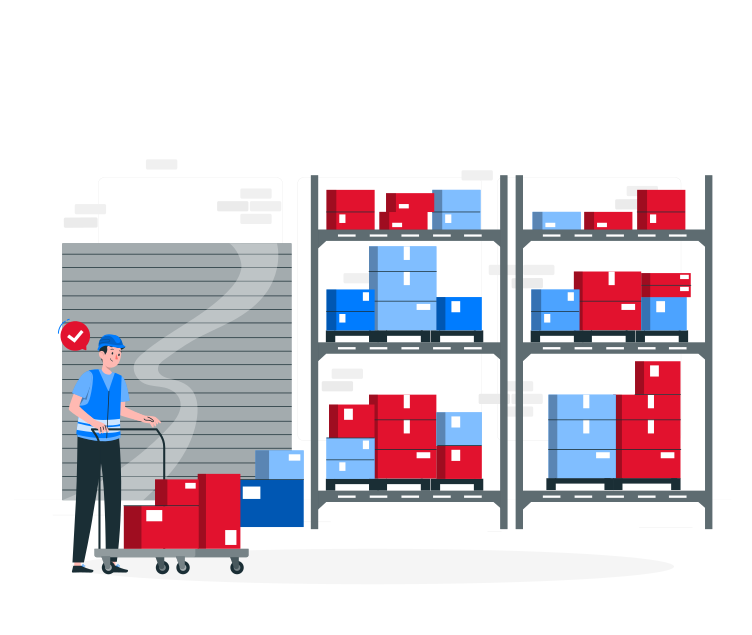
Warehouse Management is a strategic function at the heart of the supply chain, managing all movements end-to-end, from receiving and placement to replenishment, picking, shipping, returns, and quality control. A modern Warehouse Management (WMS) module integrated into an ERP system increases inventory accuracy, shortens cycle times, reduces operational costs, and improves customer service levels. For an overview of the solution, please see the Warehouse Management page.
What is Warehouse Management in ERP?
Warehouse Management within the ERP system offers a combination of standard processes, business rules, and automation to ensure stocks are in the correct location, time, and quantity . Materials and products are tracked at the lot/serial and location levels; flow policies such as FIFO/FEFO are implemented; and real-time stock movements are recorded using barcodes/RFID . WMS enhances operational visibility by exchanging data bi-directionally with Purchasing , Production , Sales & Distribution , Quality , and Finance modules.
Main Processes and Workflow
- Inbound Goods Receiving: Scheduled gate scheduling with ASN (forward dispatch notification); quantity, quality, and document checks; temporary quarantine.
- Placement (Putaway): Placement oriented according to location rules (zone, floor, weight/volume, temperature, hazard class).
- Internal Transfer & Supply: Replenishment enables automatic feeding of picking zones; task interleaving reduces empty return trips.
- Picking: Single/multiple order picking, wave, zone/batch/pick-to-light, audio picking.
- Packaging & Consolidation: Crate/pallet formation, labeling, SSCC and shipping document production.
- Outbound Shipping: Loading scheduling, gate/slot assignment, consistency with distribution plan, carrier integrations.
- Returns & Reverse Logistics: Inspection, classification (restock, scrap, rework), warranty processes.
Location, Slotting and Layout Strategies
Correct placement determines picking speed and safety. Based on ABC values and XYZ demand variability, high-volume products are classified and placed in the golden zone . Slotting algorithms suggest locations based on criteria such as product size/weight, order affinity, seasonality, and safety distance. Special zones are defined for hazardous, fragile, or temperature-controlled products.
Traceability, Quality, and Compliance
Traceability on a lot/batch basis is mandatory in regulated sectors such as recalls and pharmacovigilance . FIFO/FEFO flow policies are selected based on expiry/production dates. Quality control scenarios (sampling, AQL, quarantine) are supported upon acceptance; nonconformities are automatically routed to quality hold locations. Hazardous materials documentation such as MSDS and ADR is linked to in-warehouse alerts and work permits.
Collection and Supply Optimization
Picking is a labor-intensive activity. Wave planning enables grouping according to time windows; zone/batch picking reduces walking distance; and auxiliary systems like pick-to-cart and pick-to-light reduce error rates. Dynamic replenishment rules automatically monitor minimum and maximum limits in picking zones and create replenishment tasks.
Automation and Hardware Integrations
WMS integrates with handheld terminals, RFID gates, weighing systems, label printers, conveyors, AS/RS (automatic storage & retrieval), AMR/AGV robots, and sorters. These integrations improve data accuracy with real-time scan-in/scan-out and shorten dock-to-stock time.
Planning, Gate & Vehicle Scheduling
Appointment management for loading/unloading gates prevents queues during peak hours. Capacity is used most efficiently through vehicle load planning (package/pallet optimization) and cube calculations. Thanks to carrier integration, shipping documents and tracking numbers are generated automatically.
Inventory Accuracy and Counting Strategies
High inventory accuracy is critical for planning and customer commitments. Cycle counts are performed daily/weekly according to ABC priority; the perpetual inventory approach reduces the need for year-end closed counts . Count discrepancies are minimized through root cause analysis (incorrect labeling, location confusion, out-of-process transactions).
3PL and Multi-Storage Buildings
When working with multiple warehouses and 3PL partners, inventory visibility and standardized processes become critical. WMS manages warehouse-based policies and authorizations; addressing standards , label templates , and reporting are made consistent across the entire network.
KPIs and Operational Performance Measurement
- Stock accuracy (%): System-stock match.
- Dock-to-stock time: The time elapsed from acceptance to entry into stock.
- Order line picking time: An indicator of efficiency and capacity utilization.
- OTIF: On-time and complete delivery rate.
- Picking error rate: Cases of incorrect product/quantity.
- Area utilization: stock and turnover rate per m².
Common Mistakes and Suggested Solutions
- Non-standard addressing: Clarify the location code structure (building-floor-corridor-shelf-compartment), standardize visual signs.
- Transactions without labels: Prohibit transactions without barcodes; define HHT (Head-Up Transaction) requirements and exception flows.
- Incorrect flow policy: Make FIFO/FEFO parameters mandatory fields on a product-by-product basis.
- Weak resupply rules: Calibrate min-max and resupply triggers according to ABC/XYZ.
- Lack of training: Keep role-based training and job instructions up-to-date in visual/mini-clip format.
Implementation Roadmap
- Discovery & Data Cleaning: Location map, product master data (size/weight, hazard, expiration date), and labeling standards.
- Policy Design: FIFO/FEFO, replenishment, inventory, return, and quality control rules.
- Device & Label Infrastructure: HHT, printer, RFID gate, label templates, and test prints.
- Pilot & Continuous Improvement: A pilot in one corridor, then phased rollout; PDCA cycle with KPIs.
FAQ – Quick Answers
FIFO or FEFO? FEFO is recommended for products with sensitive expiration dates; FIFO for others. Make it mandatory on a product-by-product basis.
Is RFID necessary? Speed/traceability gains are meaningful in high-volume or regulated areas; perform a cost-benefit analysis.
How to plan cycle counting? Use products A frequently and products C infrequently according to ABC; spread them throughout the day without interrupting the operation.
Warehouse Management with Centra ERP – Key Capabilities
Centra ERP Warehouse Management provides complete visibility with its multi-location structure, lot/serial and location-level traceability, directed placement/picking, dynamic replenishment, ASN and appointment-based door management, barcode/RFID, quality and hazardous materials compliance, AMR/AGV/ASRS integrations, and KPI dashboards. Warehouse flows are quickly optimized with what-if scenarios and a business rule engine.
Conclusion and Call to Action
Warehouse Management is more than just inventory management; it's a transformative area that creates a competitive advantage based on speed, accuracy, and security . A robust WMS (Warehouse Management System) within an ERP system reduces inventory costs, increases order fulfillment speed, and makes it easier to keep your promises to customers. To see the most suitable approaches for your organization, you can visit the Warehouse Management page and create a roadmap to improve your processes based on data.
