

 Türkçe
 English
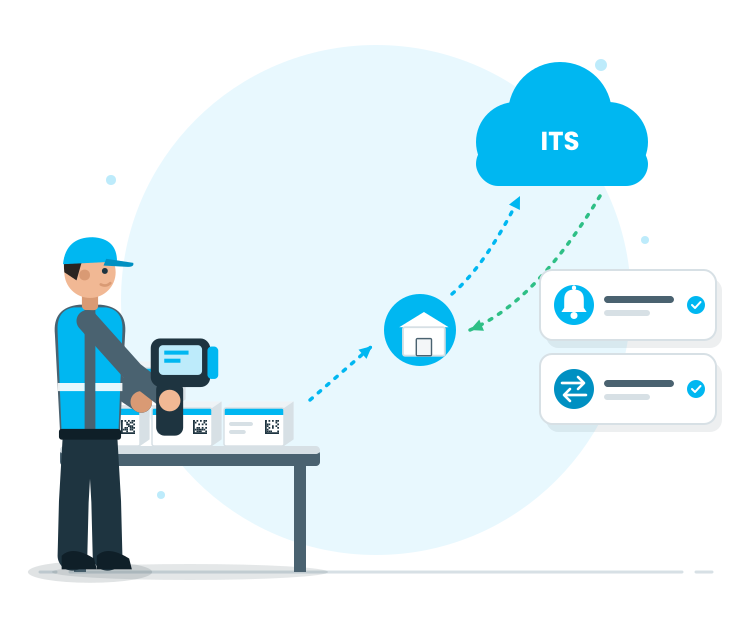
The Drug Tracking System (ITS) is the national tracking system operated by the Turkish Medicines and Medical Devices Agency, which makes it possible to track every box of human medicines from the manufacturer to the patient. Each drug box is uniquely identified by the QR code on it; every step in which the box is produced, sold, transferred and delivered to the patient is reported to the system by the stakeholders.
The purpose of ITS is to prevent counterfeit and illicit drugs from entering the supply chain, to speed up recalls, and to secure reimbursement processes. For manufacturers and pharmaceutical wholesalers, ITS is an operational discipline in which every physical movement in the warehouse must be matched by a digital notification. In this article, we cover how ITS works, what the QR code contains, and how notifications can be managed without errors with a Warehouse Management System.
How Does the Drug Tracking System Work?
1. The QR Code and the Information It Carries
The foundation of ITS is the QR code in GS1 DataMatrix format printed on the drug box. The QR code carries four key pieces of information: the GTIN that identifies the product, the serial number unique to the box, the expiration date, and the batch number. The combination of the GTIN and the serial number makes each box unique worldwide. While a classic barcode identifies only the product, the QR code identifies each individual box; two boxes of the same drug can be told apart. The printing and readability of the QR code are verified on the production line; an unreadable QR code means the box cannot move forward in the supply chain.
2. Stakeholders and Notification Types
In ITS, manufacturers and importers, pharmaceutical wholesalers, pharmacies and healthcare institutions take part as stakeholders. Each stakeholder submits the relevant notification for the boxes that pass through their hands:
- Production and import notification: The first-time introduction of the box to the system.
- Sales and purchase notification: The transfer of the box from one stakeholder to another and its receipt by the buyer.
- Return notification: The box going back to the previous stakeholder.
- Deactivation notification: The box leaving the supply chain for reasons such as destruction, sample, or export.
When someone other than the registered owner of a box in the system tries to sell it, the notification is rejected; this way, unregistered products cannot enter the chain.
3. Tracking at Carton and Pallet Level
Scanning thousands of boxes one by one in the warehouse would bring operations to a halt. For this reason, when boxes are packed into cartons and cartons onto pallets, the relationship between them is recorded and a separate label is printed for the shipping unit. This way, when a pallet is scanned, all the boxes in it can be transferred to the system. The accuracy of this relationship is critical: if a box is removed from a carton and the record is not updated, an incorrect notification is made in the next shipment. Label management manages the shipping unit labels and the content relationships.
In ITS, it is not enough for a box to physically leave the warehouse; it must also be digitally transferred to the correct recipient. Every difference between the two records means the shipment coming back from the field.
How Are ITS Notifications Managed with WMS?
4. QR Code Verification During Order Picking
Most errors arise at the picking stage: the wrong batch, a box approaching its expiration date, or a product that appears in the system as belonging to another stakeholder. During picking, the WMS instantly compares every scanned QR code with the order line, the inventory record, and the ITS status of the box; a mismatched box is rejected before the order is closed. The ITS order picking module runs these checks on the handheld terminal. For a detailed flow, you can see our ITS order picking article.
5. Automatic Submission of Notifications and Error Management
When a shipment is approved, the sales notification is prepared and sent automatically by the WMS. Every response returned from ITS is recorded; rejected boxes fall into a separate list, the reason is shown, and a correction step is offered to the user. Vehicle departure for a shipment whose notification is not completed can be blocked. This approach ensures that errors are corrected at the moment they occur, instead of hundreds of faulty notifications being cleaned up manually at the end of the month. Because the notification history is stored on a per-box basis, in a customer complaint or a recall, the date on which a specific box went to a given recipient can be found within seconds.
6. Returns, Goods Receipt, and Reconciliation
For returned products coming back from a pharmaceutical wholesaler, the QR code is scanned, it is verified whether the box was actually sold to that recipient, and the return notification is made. At goods receipt, the purchase notification for the incoming boxes is sent at the moment of scanning. At regular intervals, the WMS inventory is compared with the ownership record in ITS; differences enter the counting and correction processes. For the general framework of product Traceability, our product traceability with WMS article is a complementary read.
What is the difference between a QR code and a barcode?
A barcode identifies only the product type; all boxes of the same drug carry the same barcode. A QR code, in addition to the product number, also contains the serial number, batch, and expiration date, and identifies each box individually.
What happens if an ITS notification is not made?
The ownership of the box in the system is not updated. The receiving stakeholder cannot receive the product in the system, a difference arises between physical inventory and the ITS record, and the subsequent sale of the product is blocked.
Should the ITS integration be done in ERP or in WMS?
QR code scanning and verification should be done where the physical movement takes place, that is, in the WMS. ERP manages the order and the invoice; having the two systems work with the same data minimizes notification errors.
Conclusion: The Drug Tracking System tracks every box in the warehouse with a digital identity and requires every physical movement to be matched by a correct notification. When this discipline is carried out manually, errors and delays are inevitable; when it is verified at the moment of scanning with a WMS, notifications become a natural part of the shipment. Centra WMS manages ITS notifications embedded in the picking, shipping, return, and goods receipt flows. For your pharmaceutical manufacturer and wholesaler operations, get information.